How Does the Theme of Love Relate to the Art of Courtly Love
It's fourth dimension for February's post and I thought it would exist only plumbing equipment to write a mail service regarding the theme of love. Every bit I was beginning my inquiry and narrowing down different topics I came across a most amusing book, The Fine art of Ladylike Love, written between 1174-1184 (dates are not precise) by a clergyman by the name of Andreas Capelanus (as well known as Andreas the Chaplain). Requested past his patron, Countess Marie of Champagne (daughter of the famous Eleanor of Aquitaine and her first husband, Louis 7 of France), this book outlines the rules of ladylike dearest in the guise of a lesson to Andreas' fictional friend, Walter (who it seems has just been rejected by his beloved). However, there is more than to it than just Capelanus'southward rules. This was an of import part of social life in noble circles, at to the lowest degree and then much so that Countess Marie requested a written work on information technology. The work of Andreas Capelanus spread far through courts across Europe and began to exist printed in the 1400s. There is debate whether courtly love was actually practiced or if it was just a literary device, just, either manner, information technology seems to take been important to social club. In this post, I wanted to dive into some of the details regarding this tradition. One of the most surprising discovers is the entreatment that ladylike dearest may have held for women of this period which is supported through the patronage of Eleanor of Aquitaine and her daughter Marie of Champagne.

Information technology seems that the practise of courtly dear began in Southern French republic in Aquitaine and Provence. The practice spread to the Northern countries partly through Eleanor of Aquitaine and her marriages with Louis VII of France and Henry II of England. Her children would continue to expand the practice and traditions further. Her daughters of her first matrimony, Countess Marie and Countess Alix of Blois would spread literary interests. Countess Marie would become a patron of poets such as Chretien de Troyes (The Knight of the Cart) and of Andreas Capelanus who would write of these traditions at her requests. Eleanor's sons by Henry II (Henry, Geoffrey, and Richard) would become patrons of literature as well. Richard the Lionheart was known to etch his own poesy. It is easy to encounter why social, literary, and artistic patronage would be of an interest to Eleanor. Her family unit in Aquitaine had a history of participation in this fad. Her own grandad, Guilhem Nine of Aquitaine, was not simply a knuckles who led military campaigns, but was also one of the get-go "troubadours" and would write lyric poetry in the Occitan linguistic communication. He would write humorous and scandalous poems, only also poems that exemplified ladylike beloved:
Every joy must abase itself,
And every might obey
In the presence of Midons ['my lord', expressing homage], for the sweetness of her welcome,
For her beautiful and gentle look;
And a man who wins to the joy of her love
Will live a hundred years
The joy of her can make the sick man well over again,
Her wrath can make a well homo die,
…the courtliest man tin can become a churl,
And any churl a ladylike human…
Past the year 1170, Eleanor became estranged from her married man, Henry II, and moved back to her own hereditary domains in southern French republic. Her favored son, Richard, was but most 13 years former and had been named as the knuckles of these domains by his male parent. As Richard was so young, Eleanor would get the reigning duchess again of Aquitaine and their holdings. She would ready out with conclusion to revive her courtroom in Poitors. With her son in tow, acknowledged as the new duke, Eleanor would go on a royal tour of her lands gathering the old Aquitaine dignity creating an entourage of young nobles and prospective knights. There would exist a variety of entertainments like poetry, singing, tournaments, dancing, special events, etc. Eleanor would be a patron of the arts and provide a valuable courtly teaching for these prospective heirs. She would likewise use the rebuilding of her ducal dwelling to showcase some of the treasures she had brought home from when she traveled to Byzantium on Crusade with her first husband supporting her honey of the arts.

Countess Marie, as a daughter of Eleanor, probably knew a lot of her families poetic beginnings, just besides married into a duchy with a stiff literary tradition. Her court of dear was stationed in Troyes (her husband'south domain) and writers and poets constitute many sponsorships. She may have also been in contact with her mother every bit she ready up her court in Poitors, collaborating and sharing ideas. This was the temper Andreas the Chaplain had to write his treatise on The Fine art of Courtly Dear at the management of the Countess. There is non much known of the author except that he was a chaplain. He may not take approved of much of what he was writing almost for the Countess and this is evident in the writing, however it is ironic that it became and then popular. Some view it as a satire piece, though I believe there must be some truth in the traditions or information technology would non have been approved by his patron. Per John Jay Parry'south translation of the work, it is idea that Andreas the Clergyman was attempting to portray Queen Eleanor's court in Poitiers between 1170 and 1174 (by 1174, she had been called back to England by her husband). Information technology seems courtly love was the new fad among those of the "leisure" classes.
It tin be suspected that since society was so restrained by the church that it was natural something of courtly beloved would come virtually to provide a chip of fun in society. The church was very restrictive and did not approve of beloved in the idealized sense. One married for property and for the procreation of children and did non partake in the "sinful" grapheme of love. Women specifically were very restricted as they were to perform their duty to their family and remain obedient. Ladylike love was something outside of marriage that contradicted to all of society's expectations.
Andreas writes this treatise as if he is writing to his friend, Walter, "a new recruit of Love" in social club to teach him how to come up back from rejection and go a proper beloved. Andreas defines love as "a certain inborn suffering derived from the sigh of and excessive meditation upon the beauty of the contrary sex, which causes each one to wish above all things the embraces of the other and by mutual desire to carry out all of love's precepts in the other's embrace." However, despite the suffering, he goes on to explain, true love brings out the best traits in a person. A lover is humble and would give upwards everything, all worldly positions to attain it. Ladylike love is fickle and can always be either increasing or decreasing, which supports the importance of a written rule book.
There are five means by which dear may be acquired, per The Art of Courtly Love. These include "a beautiful figure, excellence of character, farthermost readiness of speech, great wealth, and the readiness with which one grants that which is sought." Though it is important to only larn dearest from the first three options as the other two viewed dishonorable. A practiced grapheme is the nearly important affair 1 should expect for in a potential lover, which might not be what you'd expect from a earth based on class and wealth. Money, according to Andreas, will not buy you proper love.
"A person of adept character draws the love of another person of the aforementioned kind, for a well-instructed lover, man or woman, does not decline an ugly lover if the character within is proficient.A man who proves to be honorable and prudent cannot easily become astray in beloved'due south path or cause distress to his honey. If a wise adult female selects every bit her lover a wise man, she can very easily continue her dearest hidden forever; she tin teach a wise lover to be even wiser, and if he isn't so wise she tin restrain him and make him conscientious."
Good character lies supreme over all when it comes to choosing a partner through ladylike beloved, even if physical beauty is lacking or at that place is a difference in grade (though be sure not to include peasants, clergy and prostitutes in that number, per Andreas). I believe good character would be divers by Andreas as someone who is accomplished, humble, chaste, generous, polite and courageous. This is the feeling I got from reading The Fine art of Courtly Love. On the other hand, an excess of passion would not have been bonny in a courtly lover. Animalism and disloyalty volition hurt 1's courtly dearest matter.
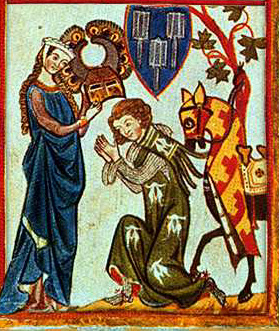
"An excess of passion is a bar to love, because there are men who are slaves to such passionate desire that they cannot be held in the bonds of love–men who, after they have idea long about some adult female…when they see another woman straightway want her embraces, they forget about the services they have received from their first dear, and they feel no gratitude for them. Men of this kind lust later on every woman they meet; their honey is like that of a shameless dog. They should rather, I believe be compared to asses, for they are moved just by that low nature which shows men are on the level of other animals rather than by that true nature which sets us apart from all the other animals by the difference of reason."
I idea it was interesting that Andreas, a man of his time, would point this out. He continues later that "if one of the lovers should be unfaithful to the other…he renders himself wholly unworthy of his onetime honey, and she ought to deprive him completely of her embraces, because the feeling of love he formerly had is at present completely gone." Andreas actually encourages the adult female to leave the homo and accepting that lover dorsum into her life would just crusade herself unneeded suffering. Andreas explains that the woman should never accept back an unfaithful man, even if he asks permission to leave. If he does ask this she should decline him immediately. I idea this was surprisingly empowering of women, during a time where they were treated as essentially property. A woman has the ability to reject a man who has wronged her through the do of courtly love.
The idea of courtly dearest tin can exist viewed as providing women with more than ability and authority. She is the the 1 to be worshiped and men are to become their projects. A adult female can cull who she wishes to bestow her favor on and when she wishes to reject advances, which contradicts the do and restraint of arranged marriages. The woman can, through her love, make a man of skillful grapheme. For instance, Andreas writes eight unlike dialogues between members of different classes and their experience pursuing courtly dear. In the dialogue between the middle form human and the noble adult female, the centre class man begs her to become his teacher and provide him with wisdom. A training in good character can make everyone noble.

The power is truly in the woman'southward manus every bit courtly honey, as it appeared to me in my research, was based on obtaining a woman'southward favor and the hope of her dear. Andreas writes that a human being should ever try to flatter his dearest early in the conversation and the dialogue'southward are riddled with this (changing depending on the grade state of affairs). He also writes that a man should be sympathetic. If he happens to offend his beloved, he must apologize immediately. A homo must always be obedient and humble and not brag to others about his honey. In his twelve rules of acquiring dear, Andreas is very specific on sure points: e'er be modest, always be polite and courteous, do not exceed the desires of the lover, and always obey the lady.
I tin can see why this practice may have been appealing to women of this era. This was a time when wedlock was used for political gain and a woman no more than a pawn. She would accept to ally as her family wished in order to enhance their fortunes. Very rarely could she be granted a divorce, as this practice was unfavorable to the Church. She was restrained and fabricated to exist obedient, yet courtly love may have been an outlet. It is one of the rules of ladylike love that marriage and truthful love are incompatible. They must and can only remain separate. In one of the dialogues a letter from Countess Marie is quoted (I do non know if this was existent or made up by Andreas): "We declare and we concur as firmly established that dearest cannot exert its powers betwixt two people who are married to each other. For loves give each other everything freely, nether no compulsion of necessity, only married people are duty spring to give in to each other'southward desires and deny themselves to each other nothing." Basically, she is proverb that matrimony is a duty, while dearest is given without concerns for wealth, status, or obligation (in theory). This is probably why another of the rules of courtly dearest is to keep it a secret!
Andreas creates a listing of 31 ultimate rules of courtly love, and though I will not share all, I believe some to be interesting:
- Spousal relationship is no real excuse of not loving
- He who is not jealous cannot dearest
- No one can be bound by a double dearest
- The which a lover takes confronting the volition of his love has no relish
- Love is always a stranger in the home of avarice
- A truthful lover does not desire to cover in love anyone except his beloved
- When made public love rarely endures
- Skillful character alone makes whatever homo worthy of love
- If love diminishes it rapidly fails and rarely revives
- A true lover considers naught good except what he thinks will please his beloved
How were these "rules" put into exercise? Poetry and song were large outlets for expression of this blazon of love. Accept these 3 verses I accept selected from Bernart de Ventadorn's,It is no wonder if I sing:
In all good religion, without deceit
I love her, the fairest and best.
I sigh in my eye and weep from my optics,
For I dear her so much that I grieve.
What more tin I do, imprisoned by Beloved
In a cell, while she keeps the key?
It will exist opened only by mercy,
And no mercy comes to me
This beloved strikes me so gently
In the heart with its sweet enjoy,
A hundred times a solar day I die in pain
And revive with joy a hundred more.
The bad in me wears a cute face up,
For my bad is better than some other human being'due south good;
And since my bad is so good for me,
The good after grief will be adept indeed…
Proficient lady, I enquire you nothing at all
Except to make me your retainer,
For I'll serve you as I would a good lord,
And never ask for another reward.
So here I am, at your command,
A frank, humble heart, ladylike and glad!
Yous're surely not a king of beasts or bear
Who'd slay me when I surrender!
Ventadorn follows the practice of courtly honey equally he is consumed by the epitome of his beloved. It is all consuming and powerful, he is searching for the promise of beloved from the woman of his eye. He asks to be her servant, he is not worthy of her just her love volition make him worthy. Near importantly, he asks for no reward, which shows he is non influenced by greed or condition.
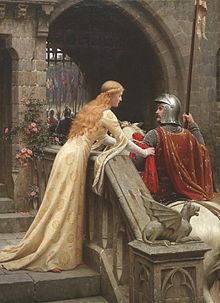
God Speed! By Edmund Blair Leighton, 1900
At that place is also an example of a female troubadour during this period who also wrote of courtly dearest. I loved finding examples of female writings. I wonder if ladylike dear actually provided more than opportunities for female troubadours?
The female troubadour who was agile during this flow was known as La Comtessa de Dia (her true identity has never been known).
The poem I selected is titled From joy and youth I take my make full:
From joy and youth I have my fill,
And joy and youth fill me upwardly;
Because my lover is a merry man,
I am merry and pretty, likewise.
And since I'm always true to him
It'southward only right he's truthful to me;
For my love for him has never waned
And wane it never shall.
I'yard pleased that he'due south a worthy man,
The one who'south worth so much to me,
And pray that those who prepare us up
God volition set in neat delight.
And if they say I do bad things
He should say no if I say it's not true;
For the man who hunts for switches
May turn out to be the ane switched
These are the first ii verses and the Comtessa de Dia is striking on the of import themes of skillful character (worth) and the importance of loyalty. These are key for a woman to expect for when she is pursuing a courtly lover during this fourth dimension. He must be worthy and true to her.
She continues in the next ii verses:
And so a lady who cares for her proper name
Must surely requite her intendance
To a worthy, noble knight.
And when she sees his worth
Allow her open up up to dearest,
For once the dearest of a lady opens,
No noble or charming homo
Will speak lightly of her charms
My man is then loftier-born and handsome
He makes merit rise even college;
Sensitive, giving, and deft,
He has the gift of wit.
I pray that he'll believe in me,
Not in others who'd make him believe
That I could ever be false to him—
Unless he were fake to me!
These verses reveal the woman'south feet regarding how her ain character is viewed past primarily her beloved. She worries that gossip and rumor will affect her lovers stance of her worth. Andreas warns of this anxiety and how it tin can crusade dear to "decrease" if it becomes all consuming. That is why trust is important, though Andreas goes on to explain that jealousy is key to increasing dear. This is a bit confusing as any tinge of unfaithfulness is bad, merely jealousy is skilful?
Andreas as well writes of the famous "Courts of Love" which were supposed councils of women who would have love cases and make a conclusion. Andreas writes of the cases that some of the women took and fabricated decisions on which include Queen Eleanor of Aquitaine, Countess Marie, and other high born ladies who were pop in the European courts. Were these "courts" existent? Probably not, only could Andreas accounts be based on events he saw or experienced? In the context of the book, they are used to illustrate the rules of dear and requite a nod to his patron. These cases would hit on the issues of spousal relationship, unfaithfulness, deciding betwixt ii loves, worthiness of character, and unusual situations (similar what if your lover lost a limb in state of war?).
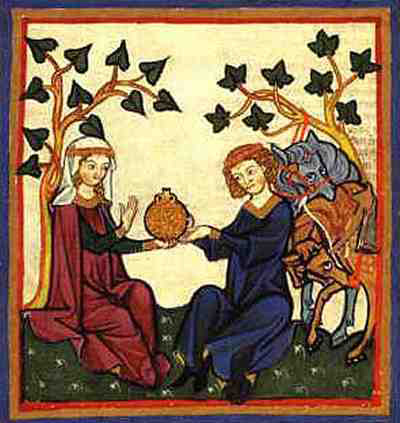
Even so, there were criticisms of the exercise of ladylike beloved. Was this just a game or did it lead to something more than sinful? Christine de Pizan, a medieval writer and early feminist, wrote about her disapproval of the practice. She believed it was really a harmful practice to the adult female who gained nothing, while the men gained more. The woman would only gain more anxiety, due to the secretive nature of the practice and so more than "dishonor and criticism" when the truth came out. She besides disagreed with the idea that marriage and dear should always exist held equally divide. Every bit a Christian also, she found courtly love to be an excuse to legitimize adultery. This is a valid criticism of do and would definitely have been distasteful to the Christian values medieval contemporaries were taught. I don't believe Andreas, as a clergyman, believed in the practise either.

Courtly love was an interesting social practice among the upper classes of medieval order which expressed itself through literature and verse. There is speculation whether it was actually practice in existent life, only in that location is evidence that the themes were rampant in the written word of the 24-hour interval. The practice was spread profoundly by Queen Eleanor of Aquitaine throughout her life and through her offspring. The practice created an outlet for those who felt constrained by the duties of medieval society and by the Churches teachings. It peradventure provided more power and freedom to the adult female, who the exercise was congenital around, whose duty to order constrained them. Still, others criticized it every bit an excuse to commit adultery and distance themselves from the Church. Overall, this has been an interesting topic to inquiry and eventually evolved into our ideas of a "perfect beloved" or "romance" today.
Thank you for taking the time to read my post! I am sorry if the formatting is a bit off. I am still trying to effigy out how to apply the new wordpress editor!
Sources:
Capellanus, Andreas. The Art of Courtly Love. Translated by John Jay Parry. New York: Columbia University Press, 1990
Paden, William D. Troubadour Poems from the South of France. Boydell & Brewer, 2007
Bogin, Meg. The Women Troubadours. Due west.W. Norton Company, 1976
Kelly, Amy. "Eleanor of Aquitaine and her Courts of Love."Speculum Vol 12, no. 1 (Jan 1937): 3-nineteen.
https://public.wsu.edu/~delahoyd/medieval/dear.html
http://www.ling.helsinki.fi/~vaasjoki/exlibris/chretien.html
"Honey as a Threat: Christine de Pizan's Reflections on Courtly Love in the Volume of The Knuckles of True Lovers" article by Safak Altunsoy
All images obtained from Google Images
Source: https://historynavigator.org/2019/02/16/545/

Отправить комментарий for "How Does the Theme of Love Relate to the Art of Courtly Love"