Little Girl Waking Up and Falling Asleep Again
© 2019 Gwen Dewar, Ph.D., all rights reserved
Nighttime wakings have a bad reputation, and no wonder. Just about everybody has experienced information technology: enkindling spontaneously in the middle of the nighttime, unable to fall back to sleep.
If yous are a parent, you too know what it's similar when somebody else keeps waking you up. A hungry babe, a crying toddler, a worried kid.
When morning arrives, you don't feel restored and energetic. Non if your sleep has been too fragmented. Not if you spent also much time awake.
So you might conclude that night wakings are unnatural, unhealthy — a sign that something has gone wrong. But science doesn't support this idea.
Aye, nighttime wakings can be associated with sleep impecuniousness and other wellness bug. If nighttime wakings are causing strife and distress, you need to find ways to meliorate the situation.
Merely night wakings aren't — past themselves — unnatural or unhealthy.
On the contrary, information technology's normal for good for you sleepers to feel many arousals from slumber during the night. An developed or child who didn't experience these arousals would be a freak of nature. Or a patient in a blackout.
Dark wakings are a bit like those unconscious movements nosotros experience at night. If you move around as well much, it tin can become disruptive. Just if you don't move enough, you put yourself at risk for serious problems.Musculus and tendon strains from remaining in the same position likewise long. Compressed and damaged fretfulness. Bedsores.
In the case of night wakings, they protect the brain from sinking besides far into deep sleep: They help ensure that sleep is reversible.
They also allow united states to continue tabs on the environment, so we tin can react more rapidly in the event of an emergency. What'south that audio?
And they make us more responsive to urgent, internal threats — like a breathing problem (Halász et al 2004; Eckert and Younes 2014).
Thus, night wakings aren't the enemy of a good night's sleep. Our goal shouldn't exist to eliminate them. Instead, we should focus on making night wakings less disruptive, and addressing the problems that prevent u.s. from falling back to sleep.
How do we do this? Information technology isn't easy, peculiarly if yous've learned to dread or resent night wakings. It pumps upwardly your stress levels, which makes it harder to sleep. The outcome is what doctors call psychophysiological insomnia. You've (inadvertently) taught your brain to respond to night wakings by becoming more alert and vigilant.
But understanding the scientific discipline of sleep can assist. Information technology tin can provide yous with a more than realistic, reassuring view of night wakings. And information technology offers practical insights for improving sleep quality.
In the residual of this article, I review the following:
- Why nobody truly "sleeps through the night"
- Why spending time awake at dark isn't intrinsically bad, or against human being nature
- Why babies wake up and then often
- How to manage nighttime wakings in young infants
- More tips for coping with confusing night wakings in children and adults
Dark wakings: Why nobody truly "sleeps through the nighttime"
Perhaps you've heard parents brag that their children are "sleeping through the night." This isn't happening in your family, and you're wondering what'southward incorrect.
Your baby seems to be a light sleeper. She'due south easily angry at night and (when things get really difficult) she seems capable of waking upwards every hour.
Or perhaps you take an older child, and wonder why he keeps waking up in the centre of the night.
Is a medical status causing these wakings? Information technology'southward possible. As I note beneath, there are conditions — similar obstructive sleep apnea and gastroesophageal reflux disease — that can trigger nighttime wakings.
Does your kid suffer from a slumber disorder? That'south possible too.
But it'due south of import to understand that night wakings are a regular feature of normal, healthy sleep.
Nobody truly "sleeps through the night," not if we hateful by this phrase "sleeping continuously in i, long, uninterrupted bout."
When scientists monitor people sleeping in the laboratory — using electroencephalograms (EEGs) — they confirm that sleepisn't a monolithic state.
Instead, nosotros cycle through a series of slumber stages (including calorie-free slumber, deep sleep, and REM, or rapid-eye movement sleep). And cortical arousals — transitions into increased wakefulness — are common.
How common?
In a study conducted in the The states, researchers used electroencephalograms (EEGs) to measure out the sleep behavior of 76 healthy adults between the ages of eighteen and 70. Across all historic period groups,sleepers averaged 80 to 130 arousals in a single night (Bonnet and Arand 2007).
To be clear, people aren't waking up "all the style" every time they experience a cortical arousal. Often, they are shifting from deep sleep into calorie-free sleep. Or from REM into light sleep.
But once we're in light sleep, we're easily awakened. And EEG studies confirm that many arousals do result in our waking upward "all the way."
The average adult may feel more than xx such awakenings each night — and more twoscore nightly awakenings after the age of 50 (Bonnet and Arand 2007).
We don't call up all these awakenings because nearly are very brief. We speedily resume sleeping, and course no memory trace.
But what if something attracts our attention during these fleeting moments of consciousness? What if nosotros hear something? What if recall of something that worries or stimulates usa?
Instead of drowsing off, we go more vigilant, more alert. Voluntarily or involuntarily, we end up spending a considerable stretch of time awake.
Then every normal, momentary shift into waking has the potential to become a lengthy episode of sleeplessness. And information technology'southward this scenario — condign alert for an extended period at night — that you may want to avoid.
Yet even here not everybody agrees.
You might accept it for granted that you lot aresupposed to sleep in one, long, continuous, nocturnal bout. Failure to do so is undesirable. Perhaps fifty-fifty pathological. This is a common folk belief in modern, Western societies.
But in other cultural settings, people take a very dissimilar view. They accept that sleep will include interruptions, and they don't perceive these interruptions to be unhealthy or pathological (Worthman and Melby 2002).
I think it'southward helpful to empathize this, fifty-fifty if you cover minimal sleep interruption every bit a goal. Considering information technology'southward harder to minimize interruptions when you're convinced that time spent awake is a pathology.
If you believe that night wakings are intrinsically bad, you're more likely to feel stressed when you realize that yous've awakened at night. This makes it harder to fall back to slumber.
Y'all're also more than probable to transmit negative feelings to your child — making it harder for your child to fall back to sleep.
And, in the long run, y'all're more likely to chronic sleep difficulties — the learned, psychophysiological indisposition that I mentioned earlier.
And so allow's take a closer wait. How do people outside the bubble of Western, industrialized societies conceptualize sleep?
The anthropology of night wakings: Why spending time awake at nighttime isn't intrinsically bad (or against human nature)
At that place'due south no doubtfulness about it. Nosotros're basically diurnal creatures — adjusted for maximizing activeness during the daytime.
But that doesn't mean nosotros need to sleep continuously from dusk to dawn. Yous already know that. And cross-cultural research demonstrates that homo slumber patterns are flexible and variable.
For example, consider the work of Roger Ekirch. He has uncovered fascinating historical evidence about sleep habits in pre-industrial Europe. People didn't lie downward at night and expect to become all their sleeping done in a single bout. Instead, they went to sleep in the evening for a few hours, woke upwards, and engaged in activities. Then, an hour or two afterwards, they resumed sleeping until morning (Ekirch 2005).
Did people retrieve they were suffering from insomnia? Far from it. They took it for granted that this was a good way to cope with long nights (Ekirch 2005).
Similarly, people living in a variety of non-Western, traditional cultures take been known to take their sleep in multiple sessions (Worthman and Melby 2002; Samson et al 2017b). And they don't pathologize night wakings. Even if they terminate up spending a considerable amount of time awake, they view their sleep habits equally normal.
For example, when anthropologists measured sleep in three traditional foraging societies, they confirmed that adults woke up multiple times during the night. The full elapsing of this waking time — what researchers phone call "wake later on sleep onset" – averaged 80 minutes or longer (Yetish et al 2015).
Yet when anthropologists asked these same people if they experienced problematic dark wakings, very few individuals saw it that fashion (Yetish et al 2015). Less than 3% of adults reported having slumber maintenance bug more than once per twelvemonth.
Or take a recent sleep study conducted on Hadza hunter-gatherers in E Africa.
Parents and other caregivers averaged approximately2 hours of "wake after sleep onset" each night (Crittenden et al 2018).
Only none of these adults — each of whom shared a sleeping space with at to the lowest degree one infant or child — viewed themselves as sleep-deprived.
When asked, all of them said they were getting plenty sleep at dark (Crittenden et al 2018).
Remarkably, this was true fifty-fifty for breastfeeding mothers. Just having a baby — spending the dark with a baby — didn't, by itself, crusade sleep problems.
And while things might be unlike for you, it's worth noting: Even in mod, industrialized societies, infant night wakings don't always crusade trouble.
Night wakings without strife: Babies tin awaken without making you miserable
Remember those boasting parents we mentioned before? The ones who claim their babies sleep through the night?
Strictly speaking, they're mistaken. Their babies are waking up at night, just like anybody else's. But there is an important deviation.
These babies aren't waking up their parents.
Thus, parents are wrong to believe their babies don't wake up. Just they may be accurate when they report a lack of sleep disruption.
And if you're thinking, "this isn't me — I always know when my baby awakens!" call back again. A recent study — conducted in an urban, Westernized population — suggests that "under the radar" night wakings are pretty common.
The researchers measured sleep two ways — (1) past fitting infants with sensors, and (two) past request parents for their subjective impressions. There were more than 200 babies total, and information was collected in the infants' own homes, for five nights.
Did the researchers document lots of night wakings overall? Yous bet. But when researchers compared their objective measurements against the subjective, parental reports, at that place was a big mismatch.
Babies were waking upwardly more often than their parents realized. The infants awoke spontaneously, remained relatively quiet, and fell back to slumber on their own — their parents none the wiser(Tikottzky and Volkovich 2019).
The pattern was evident when the babies were merely 3 months old. And in subsequent tests — when the babies were older — the gulf between objective and subjective measurements widened. Over time, parents became increasingly unaware of their children's dark wakings.
So night wakings don't inevitably trigger sleep problems. People can feel well-rested despite awakening during the night. And parents aren't ever bothered past their children'due south wakings. Information technology's but when a child fails to cocky-settle — and parents feel serious sleep disruptions — that nosotros perceive night wakings to exist problematic.
Simply babies are unusually difficult, right? Why do babies wake upwardly so frequently?
Start, in that location'southward the baby'southward "inner clock."
Immediately later on nativity, babies lack stiff circadian rhythms. Their slumber schedules can be out of sync with the natural cycle of solar day and night.
2nd, young babies need to feed during the nighttime.
They are born hungry. Their stomachs are small. They demand to refill their tanks frequently to reach the normal pattern of apace growth during the beginning viii-12 weeks.
Third, babies have their own, distinctive sleep stages.
During the showtime iii months postpartum, babies spend well-nigh of their sleep-time in a phase called "active sleep." It's the infant counterpart to REM, and it's particularly restless. Babies twitch, thrash around, and even vocalize.
This can fool us into thinking our infants are awake. Then nosotros intervene, and, in doing then, we rouse our babies from sleep. We've acquired a night waking! Alternatively, all that thrashing around tin can sometimes cause an infant to awaken himself.
Put these iii factors together, and we get a whole lot of wakefulness during the night.
For example, in a study that recorded the sleep patterns of good for you two- and 9-month sometime infants, babies averaged 3 major awakenings each night (Anders 1978).
And some other study found that approximately 50% of 4-month-onetime babies were waking their parents upward at least once between the hours of midnight and five a.k. (Henderson et al 2010).
What's the solution? How tin we manage nighttime wakings in young babies?
To some degree, nosotros simply have to be patient. These are developmental problems. Only in that location are some things we tin can do to help.
For instance, when it comes to circadian rhythms, we tin can betrayal babies to powerful environmental cues. These volition help babies modulate their "inner clocks" more quickly. Read more nigh it in my article about newborn sleep.
In improver, you might find it easier to cope with nighttime meals if you lot try "dream feeding." For more about this approach, see this Parenting Science guide.
What almost active sleep? Dealing with all that racket, restlessness, thrashing?
But learning about it is helpful. Once you know the signs of active sleep, you can avoid swooping in too soon, and inadvertently waking your sleeping baby.
It's also possible that swaddling — adept safely — can reduce the chances that your baby wakes him or herself upwardly (Gerard et al 2002; Franco et al 2005; Meyer and Erler 2001). For the details, meet tip #4 in my commodity well-nigh opens in a new windowinfant sleep aids.
And when your babe's sleep patterns are driving you crazy, console yourself. Agile sleep is probably doing something of import for your babe.
One interesting theory is that babies twitch and motion during sleep considering their brains are decorated testing and mapping out the connections between nerves and skeletal muscles (Peever and Fuller 2017).
Another idea is that agile sleep is protective. Immature infants are at special run a risk for sleep-related breathing emergencies — emergencies believed to cause SIDS, or opens in a new windowsudden infant decease syndrome. So spending time in active sleep — a state in which babies are hands awakened — may help reduce this risk.
And what else? What if a baby wakes frequently, and fails to self-settle? What if an older child keeps waking upwards?
There are indeed other measures to accept. Here are some bear witness-based tips.
1. Brand sure you lot aren't training your child to awaken.
If your child wakes yous up in the centre of the nighttime, try to go on things dark, quiet, and calm.
Yous don't want it to turn into a social event — or a scolding session. Either scenario will heighten your child'due south alertness. And if it happens repeatedly, your child may learn to associate awakening with these outcomes. You are training your child to go active and alert in response to dark wakings!
2. Sentinel out for nightlights and other sources of illumination — they tin can annul a kid's natural drowsiness
As I note in this commodity, electric lights and electronic devices emit wavelengths that interfere with the trunk'due south production of melatonin, the hormone of drowsiness.
3. Use bedtime routines, and other tactics to help your kid relax.
If you teach children to associate their beds with drowsiness and security, they will take an easier fourth dimension settling themselves to slumber later on a night waking. For aid, see my article nigh opens in a new windowgentle sleep training.
In add-on, check out these opens in a new window15 tips for better baby sleep, and my opens in a new windowtrouble-shooting guide to handling bedtime problems in infants and older children.
4. Talk to your physician about any medical concerns.
A variety of medical weather condition can cause nighttime wakings. These include
- asthma (Fagnano et al 2011),
- atopic dermatitis or eczema (Fishbein et al 2015),
- float problems and bed-wetting,
- gastric reflux, or heartburn (Lim et al 2018),
- headaches (Tran and Spierings 2013; Long et al 2010; Zarowski et al 2007; Carotenuto et al 2005), and
- slumber apnea.
If you lot discover signs of these problems, or otherwise suspect that your child is in pain, be sure to consult with your doc. For more information virtually bed-wetting, meet opens in a new windowthis Parenting Science guide.
5. Don't ignore snoring.
Not every snore or snuffle is a sign of trouble. But in many cases, snoring is a symptom of obstructive slumber apnea, one the conditions mentioned above. And sleep apnea doesn't merely cause frequent dark wakings. It can likewise restrict the oxygen supply to the brain and cause serious health issues (e.g., Fukumizu et al 2005; Hiscock et al 2007; Shur-Fen Gau 2006).
Then if you detect snoring — or other types of disordered breathing during sleep — talk to your dr..
six. Address nighttime fears and separation anxiety.
Non surprisingly, kids with nighttime fears are more than probable to experience sleep disruptions (Petit et al 2006; Gregory et al 2005; Kushnir and Sadeh 2011; Meltzer et al 2013).
Some people think that sleep training is the answer, but there is no evidence that night fears or separation anxiety will diminish as a upshot of sleep training.
In fact, sleep training (like the opens in a new windowFerber method) isn't designed to treat fear and anxiety. So if y'all implement sleep training alone, you are effectively ignoring your child's fears. And that tin make things worse.
Thus, it's important to accept an active role in teaching your kid to overcome his or her fears. For more than data, come across this article on opens in a new windownighttime fears in children.
7. Pay attending to other sources of stress.
You don't have to suffer from nighttime anxieties to experience sleep disruption. The stresses and anxieties that you lot feel during the daytime can take also have an touch.
For example, children slumber more poorly when their parents are depressed (Ystrom et al 2017).
They experience more than sleep disruptions when their parents fight (Rhoades et al 2012; El-Sheikh et al 2015).
And babies wake upwardly more frequently at night when they alive in socioeconomically deprived neighborhoods (Grimes et al 2019).
The takeaway? Kids are similar the states. Being stressed-out during the day causes sleep problems at night. So pay attending to your child's stressors. Reduce sources of stress, and assistance your child cope. For tips, see these Parenting Science manufactures:
- opens in a new windowStress in babies: An testify-based guide to keeping babies calm, happy, and emotionally healthy
- opens in a new windowPositive parenting tips: Getting better results with sense of humour, empathy, and diplomacy
- opens in a new windowEmotion coaching: Helping kids cope with negative feelings
- opens in a new windowParenting stress: 10 testify-based tips for making life amend
8. Acquire how to handle nightmares and dark terrors.
Both nightmares and night terrors can cause sleep disruption. But they are very singled-out phenomena.
Children having nightmares usually announced to exist asleep. They might twitch; they might sigh. But they are unremarkably lying in bed, eyes closed. And they are relatively repose. When they wake upwardly, they may recollect the nightmare.
By contrast, children having dark terrors often appear to exist awake. They might scream, cry, or talk. The might open their eyes. They might sit up, or walk effectually. But they aren't fully conscious, and they rarely recollect these experiences later.
If nightmares or night terrors are the problem, yous need to acquire more than about them. For more than data, see this Parenting Science article on opens in a new windownightmares and nighttime terrors in children.
More reading
For more evidence-based data, see this alphabetize to Parenting Science articles about sleep.
References: Nighttime wakings in children
Anders TF. 1978. Domicile-recorded sleep in 2- and 9-month one-time infants. Journ Am Acad Child Adolesc Psychiatry 17: 421-432.
Barbato M, Barker C, Bender C, et al.1994. Extended slumber in humans in xiv hour nights (LD 10:fourteen): relationship between REM density and spontaneous awakening. Electroencephalogr Clin Neurophysiol. 90:291-297.
Bonnet MH and Arand DL. 2007. EEG Arousal Norms by Age. J Clin Sleep Med. 3(iii): 271–274.
Carotenuto M, Guidetti V, Ruju F, Galli F, Tagliente FR, and Pascotto A. 2005. Headache disorders as risk factors for sleep disturbances in schoolhouse aged children. J Headache Pain. 2005 Sep;6(iv):268-seventy.
Chang YS and Chiang BL. 2018. Sleep disorders and atopic dermatitis: A two-mode street? J Allergy Clin Immunol. 142(4):1033-1040.
Crittenden AN, Samson DR, Herlosky KN, Mabulla IA, Mabulla AZP, McKenna JJ. 2018. Infant co-sleeping patterns and maternal slumber quality amongst Hadza hunter-gatherers. Sleep Health. 4(6):527-534
Dement Due west and Vaughan C. 1999. The promise of sleep. New York: Random House.
Eckert DJ and Younes MK. 2014. Arousal from sleep: implications for obstructive sleep apnea pathogenesis and handling. J Appl Physiol 116(three):302-13.
Ekirch AR. 2005. At Solar day's Close: Night in Times Past. New York: WW Norton.
El-Sheikh Chiliad, Buckhalt JA, Mize J, and Acebo C. 2006. Marital conflict and disruption of children's slumber. Child Dev. 77(1):31-43.
El-Sheikh M, Buckhalt JA, Keller PS, Granger DA. 2008. Children'due south objective and subjective sleep disruptions: Links with afternoon cortisol levels. Health Psychol. 27(i):26-33.
El-Sheikh M, Hinnant JB, Erath SA. 2015. 6. Marital conflict, vagal regulation, and children'southward sleep: a longitudinal investigation. Monogr Soc Res Child Dev. 2015 Mar;fourscore(ane):89-106.
Fagnano Thou, Bayer AL, Isensee CA, Hernandez T, Halterman JS. 2011. Nocturnal asthma symptoms and poor sleep quality amidst urban school children with asthma. Acad Pediatr. 11(vi):493-9.
Fishbein AB, Vitaterna O, Haugh IM, Bavishi AA, Zee PC, Turek FW, Sheldon SH, Silverberg JI, Paller Equally. 2015. Nocturnal eczema: Review of sleep and circadian rhythms in children with atopic dermatitis and future research directions. J Allergy Clin Immunol. 136(five):1170-seven.
Fukumizu G, Kaga Yard, Koyama J, and Hayes MJ. 2005. Sleep-related nighttime crying (Yonaki) in Japan: A community-based study. Pediatrics 115: 217-224.
Garthus-Niegel S, Horsch A, Bickle Graz M, Martini J, von Soest T, Weidner K, Eberhard-Gran M. 2018. The prospective relationship betwixt postpartum PTSD and child sleep: A ii-year follow-upwardly study. J Bear on Disord. 241:71-79.
Gregory AM and Eley TC. 2005. Sleep problems, anxiety and cognitive way in school-anile children. Infant Child Dev. 14:435-444.
Grimes Thousand, Camerota One thousand, Propper CB. 2019. Neighborhood deprivation predicts baby sleep quality. Sleep Health. 5(two):148-151.
Hiscock H, Canterford L, Ukoumunne OC, and Wake Thou. 2007. Adverse associations of slumber problems in Australian preschoolers: national population study. Pediatrics 119(ane):86-93.
Honaker SM, Meltzer LJ. 2014. Bedtime issues and night wakings in young children: an update of the evidence. Paediatr Respir Rev. 15(4):333-nine.
Holley S, Hill CM and Stevenson J. 2010. A comparison of actigraphy and parental study of sleep habits in typically developing children aged half dozen to 11 years. Behav Slumber Med. eight(1):xvi-27.
Jenni OG, Fuhrer HZ, Iglowstein I, Molinari 50, Largo RH. 2005. A longitudinal report of bed sharing and sleep problems among Swiss children in the commencement 10 years of life. Pediatrics 115(ane Suppl):233-twoscore.
Kushnir J and Sadeh A. 2011. Sleep of preschool children with night-time fears. Sleep Med. 12(ix):870-iv.
Kushnir J and Sadeh A. 2013. Correspondence between reported and actigraphic sleep measures in preschool children: the role of a clinical context. J Clin Sleep Med. 9(11):1147-51.
Lim KG, Morgenthaler TI, Katzka DA. 2018. Sleep and Nocturnal Gastroesophageal Reflux: An Update. Chest. 154(four):963-971
Long Air-conditioning, Krishnamurthy V, and Palermo TM. 2008. Sleep disturbances in school-age children with chronic pain. J Pediatr Psychol. (3):258-68.
Meltzer LJ, Avis KT, Biggs Southward, Reynolds AC, Crabtree VM, Bevans KB. 2013. The Children's Report of Sleep Patterns (CRSP): a self-written report measure of sleep for school-aged children. J Clin Sleep Med. 9(3):235-45.
Moore M, Allison A, and Rosen CL. 2006. A review of pediatric nonrespiratory sleep disorders. Chest 130(4): 1252-1262.
Moore K, Meltzer LJ, and Mindell JA. 2007. Bedtime problems and dark wakings in children. Sleep Med Clin 2: 377-385.
Petit D, Touchette E, Tremblay RE, Bolvin M, and Montplaiser J. 2006. Dyssomnias and parasomnias in early childhood. Pediatrics 119: e1016-e1025.
Peever J, and Fuller PM. 2017. The Biology of REM Sleep. Curr Biol. 27(22):R1237-R1248.
Rhoades KA, Leve LD, Harold GT, Mannering AM, Neiderhiser JM, Shaw DS, Natsuaki MN, Reiss D. 2012. Marital hostility and kid slumber problems: directly and indirect associations via hostile parenting. J Fam Psychol. 26(four):488-98.
Sadeh A. 1996. Stress, Trauma, and Slumber in Children. Child and Adolescent Psychiatric Clinics of Northward America v(3):685-700.
Sadeh A, Raviv A, and Gruber R. 2000. Sleep patterns and sleep disruptions in school-age children. Developmental Psychology 36: 291-301.
Samson DR, Crittenden AN, Mabulla IA, Mabulla AZ, Nunn CL. 2017a. Hadza sleep biology: Evidence for flexible sleep-wake patterns in hunter-gatherers. Am J Phys Anthropol. 162(3):573-582.
Samson DR, Mitt MB, Krystal Advertizement, Fakir Due east, Yu JJ, Nunn CL. 2017b. Segmented sleep in a nonelectric, modest-scale agronomical society in Madagascar. Am J Hum Biol. 29(4).
Shur-Fen Gau S. 2006. Prevalence of sleep issues and their clan with inattention / hyperactivity among children aged six-xv in Taiwan. Journal of Sleep Research 5(4): 403-414.
Tikotzky L and Volkovich E. 2019. Infant nocturnal wakefulness: a longitudinal written report comparison iii sleep assessment methods. Slumber. 42(1).
Tran DP and Spierings EL. 2013. Headache and insomnia: their relation reviewed. Cranio. 31(3):165-seventy.
Worthman CM and Melby M. 2002. Toward a comparative developmental ecology of homo sleep. In: Adolescent Sleep Patterns: Biological, Social, and Psychological Influences, M.A. Carskadon, ed. New York: Cambridge University Press, pp. 69-117.
Yetish Thousand, Kaplan H, Gurven K, Forest B, Ponzer H, Manger PR, Wilson C, McGregor R, and Siegel J. 2015. Natural sleep and its seasonal variations in 3 preindustrial societies. Current Biology 25(21):2862-2868.
Ystrom Due east, Hysing M, Torgersen L, Ystrom H, Reichborn-Kjennerud T, Sivertsen B. 2017. Maternal Symptoms of Anxiety and Depression and Child Nocturnal Awakenings at 6 and 18 Months. J Pediatr Psychol. 42(x):1156-1164
Zarowski G, Młodzikowska-Albrecht J, Steinborn B. 2007. The sleep habits and sleep disorders in children with headache. Adv Med Sci. 2007;52 Suppl 1:194-half dozen.
Content concluding modified 11/19
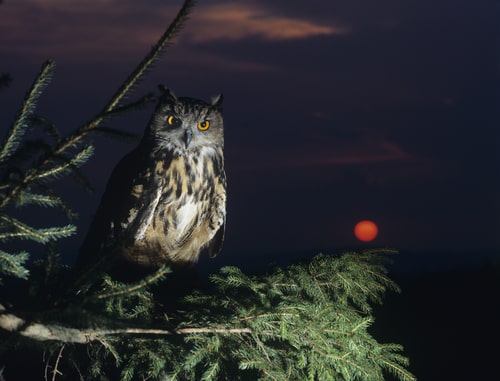
large image of eagle owl in tree by sirtravelalot/ shutterstock
small image of hawkeye owl ©iStockphoto.com/Dirk Freder
Source: https://parentingscience.com/night-wakings/

Отправить комментарий for "Little Girl Waking Up and Falling Asleep Again"